MOQ Explained: Understanding Minimum Order Quantity from China
March 19, 2026Factory vs Trading Company in China: How to Identify the Difference
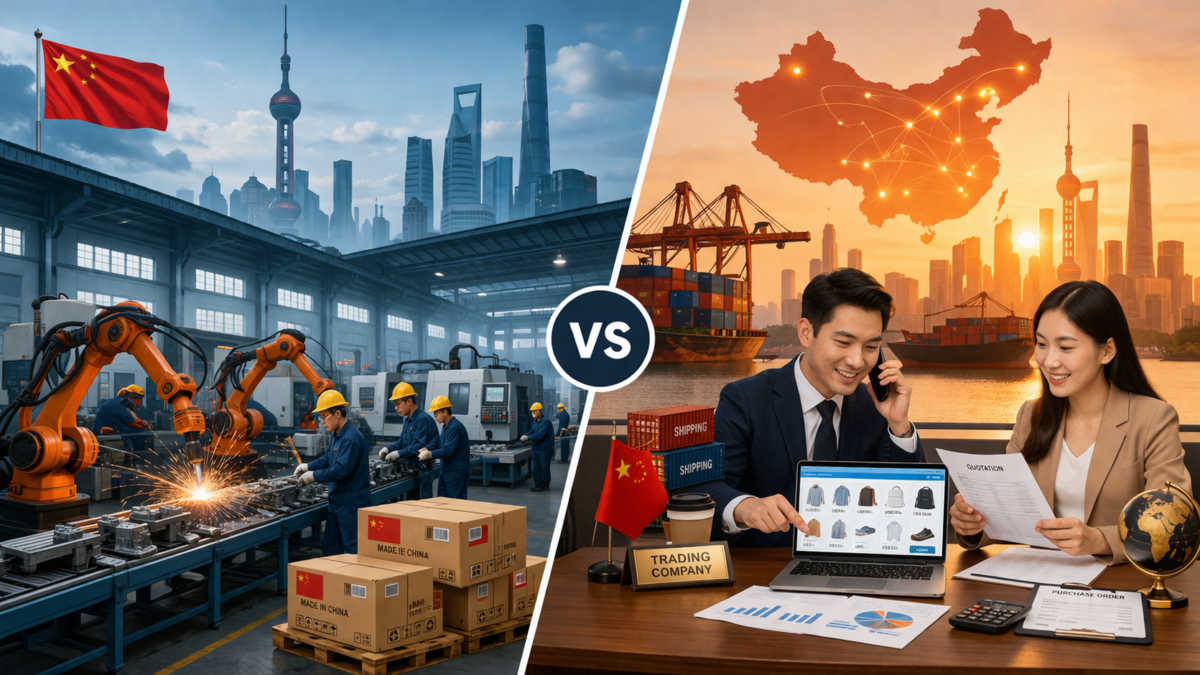
Importing from China can be highly profitable, but only if you work with the right type of supplier. In China, that usually means choosing between a factory (manufacturer) and a trading company. Understanding the difference, how to identify each, and when to use which is critical for your margins, quality, and long‑term success.
Below is a detailed, SEO‑optimized pillar guide on “Factory vs Trading Company in China: How to Identify the Difference,” followed by how a professional sourcing company can help you get the best of both worlds.
1. Why It Matters: Factory vs Trading Company
When you source from China, your supplier is either:
-
A manufacturing factory (they produce the goods themselves), or
-
A trading company (they buy from factories and resell to you).
This decision affects:
-
Your purchase price and profit margin
-
Product quality and consistency
-
Lead times and flexibility
-
Communication and problem solving
-
Long‑term scalability of your business
If you treat a trading company like a factory, or a factory like a trading company, you can end up with higher costs, quality issues, and weak control over your supply chain.
Example:
If you are launching a private label brand and need custom packaging, new molds, and long‑term product improvements, a real factory is usually the better strategic partner, while a trading company may be better if you want to test many different products in small quantities.
2. What Is a Factory in China?
A factory (also called manufacturer or OEM/ODM supplier) is a company that owns machines, production lines, and workers to physically produce products.
2.1 Core characteristics of a factory
-
Owns production lines, machinery, and tooling
-
Employs production workers, technicians, and QC teams
-
Usually located in industrial zones or manufacturing clusters
-
Typically specialized in a narrow product category
-
Can offer OEM (your brand on their existing designs) and ODM (custom designs)
-
Often has higher minimum order quantities (MOQs)
-
May have weaker English skills and slower communication
-
Sometimes uses a separate export company for documentation
2.2 Strengths of working with factories
-
Lower per‑unit price (no middleman margin)
-
Better control over product quality and specifications
-
Easier to develop new products and customizations
-
Direct feedback from the production team
-
Stronger long‑term partnership potential
2.3 Common weaknesses
-
Higher MOQs, especially for customized orders
-
Less flexible when you want many different product types
-
Communication can be slower or less “sales‑oriented”
-
Less structured for small buyers who place inconsistent orders
3. What Is a Trading Company in China?
A trading company is a middleman between you and the factory. It does not own manufacturing equipment; instead, it cooperates with various factories and resells products to you with a markup.
3.1 Core characteristics of a trading company
-
Does not own production lines or manufacturing machinery
-
Often located in office buildings or commercial centers
-
Sells a wide product range across multiple categories
-
Stronger foreign language and export know‑how
-
Usually offers lower MOQs, especially for standard products
-
Can consolidate products from multiple factories in one shipment
-
May provide extra services such as inspection, packaging, and shipping coordination
3.2 Strengths of working with trading companies
-
Easier communication, especially for new importers
-
Lower MOQs and more flexibility to test products
-
Access to a wide range of related or unrelated products
-
Faster initial sourcing if you lack experience or time
-
They may already know which factories are reliable within a niche
3.3 Common weaknesses
-
Higher price due to the middleman margin
-
Less transparency about which factory is actually producing
-
Weaker control over production and quality if they switch factories
-
Potential inconsistency between orders when they change suppliers
-
Harder to implement deep technical improvements or long‑term R&D
4. Key Differences at a Glance
4.1 High‑level comparison
5. How to Identify a Factory vs Trading Company (Step‑by‑Step)
Many suppliers on B2B platforms call themselves “manufacturers” even when they are clearly traders. To protect your business, you must know how to verify what they really are.
Below are practical checks you can perform.
5.1 Check their product range
Factories are usually focused. Trading companies are usually broad.
-
Real factory:
Sells variations of one main product category.
Example: Only LED lights and related components; only office chairs and related furniture. -
Trading company:
Sells many unrelated categories.
Example: Offers kitchenware, toys, electronics, clothing, and pet products under one profile.
Rule of thumb:
Focus = factory tendency.
Variety = trading trend.
5.2 Analyze their address and location
-
Factories:
Located in industrial zones, manufacturing parks, or rural industrial areas.
Address often includes “Industrial Zone,” “Industrial Park,” or “Factory District.” -
Trading companies:
Located in city centers, office towers, or commercial buildings.
Address often includes “Business Center,” “Building,” or purely office addresses.
You can cross‑check by:
-
Putting the address into maps (e.g., Google Maps, Baidu Maps).
-
Using satellite view or street view to see if it’s an office building or an industrial compound.
If the “factory” address is on the 18th floor of a glass office tower, it’s almost certainly a trading company.
5.3 Review their business license and registration
When you get serious with a supplier, request:
-
Chinese business license (营业执照), ideally in PDF or clear photo
-
Export license or export company details (if they sell directly overseas)
What to check:
-
Company name:
Words like “Manufacturing,” “Factory,” “Industrial,” “Technology Co., Ltd.” can suggest a factory, though not 100% proof. -
Business scope (经营范围):
If it lists “production, manufacturing, processing,” that is a positive sign for a factory.
If it lists mostly “wholesale, trading, import/export,” it leans toward a trading company.
Remember, registration names can be confusing. Some factories keep a separate “trading” company for exports.
5.4 Ask detailed technical questions
Factories know their production; trading companies know sales.
Ask questions such as:
-
What materials and specifications are used (e.g., type of steel, plastic grade, chip brand)?
-
What machines do you use in production (brand, model, capacity)?
-
What is your monthly production capacity for this item?
-
What is your standard lead time, and what steps are involved?
-
How do you control quality during production (IQC, IPQC, FQC, OQC steps)?
A real factory can usually answer quickly and specifically.
A trading company may give vague, generic, or inconsistent answers, or they need “to ask the factory” frequently.
5.5 Request factory photos and live video
You can ask for:
-
Photos of production lines, machinery, raw materials, and warehouse
-
Photos of workers on the line and QC stations
-
Short video walkthrough of the workshop
-
Live video call from the workshop if possible
Look for:
-
Actual production activities, not just a showroom
-
Multiple machines and workers, not staged pictures
-
Consistency between their claimed capacity and what you see
Trading companies sometimes rent a small workshop or borrow photos, so this is not 100% foolproof, but combined with other checks, it is very helpful.
5.6 Compare their catalog depth vs. specialization
-
Factory:
Deep variations of one product (sizes, colors, materials of the same item).
Often able to customize components and structure. -
Trading company:
Shallow coverage across many different product categories.
If you see a supplier with 50+ completely different products, you are likely dealing with a trading company.
5.7 Visit the supplier or arrange an independent audit
The most reliable method is an on‑site audit:
-
You or your team visit the “factory” in person.
-
Or you hire a third‑party inspection company / sourcing company to audit.
An audit typically includes:
-
Verifying the address and facilities
-
Checking machines, production lines, and warehouse
-
Reviewing employee headcount and working conditions
-
Reviewing quality control processes and records
-
Confirming key details against their documents
If what you see does not match their claims, you know where you stand.
6. Pros and Cons: When to Choose a Factory or Trading Company
There is no absolute “best” option. The right choice depends on your business model, order volume, and product strategy.
6.1 When a factory is better
You should lean toward working directly with factories if:
-
You have or plan to build a strong brand
-
You want custom products, new tooling, or deep product improvements
-
You place medium to large orders
-
You need consistent quality across repeat orders
-
You value long‑term cost control and direct communication with production
Typical use cases:
-
Private label brands on Amazon, Shopify, and retail channels
-
Long‑term B2B products (e.g., industrial components)
-
High‑value products where quality and IP are critical
6.2 When a trading company is better
You should lean toward trading companies if:
-
You are just starting and want to test multiple products quickly
-
You have low order volumes and cannot meet factory MOQs
-
You need a wide range of different products in one shipment
-
You need smoother communication and basic hand‑holding
-
Your product is mature, standard, and not very customized
Typical use cases:
-
Dropshippers and small e‑commerce stores testing new niches
-
Wholesalers needing mixed containers of different items
-
Seasonal or opportunistic buying where long‑term continuity is less critical
7. Common Myths About Factories and Trading Companies
7.1 “Trading companies are always bad”
Not true. Trading companies can add real value:
-
They consolidate orders from many factories, saving you time.
-
They can negotiate with factories more effectively if they have volume.
-
Some specialize in a niche and know the best factories in that segment.
The problem is not that they exist, but whether their margin and opacity hurt your long‑term strategy.
7.2 “Factories are always cheaper”
Often, but not always.
-
For low volume orders, some factories give worse prices than a trading company that aggregates volume.
-
A trading company might have better terms with factories because of their overall ordering power.
Also, factories may offer “good price” but:
-
Require high MOQs
-
Charge extra for customization, packaging, and small changes
-
Are less flexible with payment and shipping options
So you must always compare total landed cost, not just the ex‑factory price.
7.3 “If they say they are a factory, it must be true”
On online platforms, many suppliers choose “Manufacturer” because they think it looks better, even when they are pure traders. Treat all claims as unverified until you do your due diligence.
8. Practical Checklist: How to Verify Your Supplier Type
Use this simple checklist when talking to a potential supplier:
-
Product range
-
Is it narrow and specialized (factory‑like) or very broad (trader‑like)?
-
-
Company address
-
Does it look like an industrial area or an office tower?
-
-
Business license
-
Does the scope include manufacturing or just trading/import‑export?
-
-
Technical knowledge
-
Do they know materials, machines, processes, and capacity details?
-
-
Factory evidence
-
Can they provide workshop photos, videos, or live calls?
-
-
Response patterns
-
Do they often say, “I need to check with my factory”?
-
-
MOQ and flexibility
-
Very low MOQs across many products often indicate a trading company.
-
-
On‑site audit
-
If the project is important, invest in an audit or inspection visit before locking in.
-
9. Frequently Asked Questions(FAQs)
9.1 Factory vs trading company: which is better for Amazon FBA?
If you are building a long‑term Amazon FBA brand:
-
A real factory is usually better for:
-
Customizing products to stand out from competitors
-
Ensuring consistent quality across batches
-
Owning molds and protecting your differentiation
-
Negotiating better prices as your volume grows
-
-
A trading company can work when:
-
You are testing many products and niches
-
Your initial orders are small
-
You need quick access to multiple product categories
-
Professional FBA sellers often start with trading companies for testing, then migrate to factories once they find winning products.
9.2 Is it okay to work with a trading company if I want to grow?
Yes, as long as:
-
They are transparent about the factory they use, and
-
You have the option to visit or audit that factory later, and
-
The trading company adds value (consolidation, quality checks, strong service), not just markup.
9.3 Should I always try to “cut out” the trading company?
Not always. If the trading company:
-
Manages multiple factories,
-
Handles QC, communication, and coordination, and
-
Gives you stable supply and performance,
Their margin may be worth paying, especially if your volume is not yet high enough to leverage factory‑direct advantages.
10. Risk Management: Quality, IP, and Communication
Regardless of whether you choose a factory or trading company, risk management should be central to your China sourcing strategy.
10.1 Quality risk
-
Always use clear specifications, drawings, and quality standards.
-
Never rely only on photos or informal chats.
-
Implement pre‑shipment inspections by a third party.
-
For new or critical orders, consider during‑production inspections (DUPRO).
10.2 Intellectual property (IP) and product ideas
-
Use NDAs and manufacturing agreements where possible.
-
Avoid giving full designs to multiple suppliers during the early stages.
-
Consider splitting key components across different suppliers if feasible.
Factories have direct access to your designs and tooling; trading companies may share your ideas with multiple factories. Proper contracts and careful supplier selection are essential.
10.3 Communication and expectations
-
Confirm everything in writing: specifications, packaging, delivery date, payment terms, penalties.
-
Use simple, clear English and visual references (photos, drawings).
-
Document all changes and approvals in the same chat/email thread.
-
Schedule regular updates during production.
Clear communication dramatically reduces surprises, regardless of supplier type.
11. The Strategic Role of a Sourcing Company
Even after you understand the differences between factories and trading companies, doing all the verification, negotiation, and follow‑up yourself can be time‑consuming and risky—especially if you are not in China.
This is where a professional sourcing company becomes extremely valuable.
11.1 What a sourcing company does for you
A Sourcing Company acts as your on‑ground team in China and helps you:
-
Identify and vet real factories
-
Avoid weak or purely opportunistic trading companies
-
Negotiate better prices and terms
-
Oversee production and quality
-
Coordinate branding, packaging, labeling, and documentation
-
Handle or assist with logistics and shipping
Instead of you trying to decode Chinese addresses, verify licenses, and manage time zones, the sourcing company does the heavy lifting while you focus on sales and brand building.
11.2 How sourcing companies find and verify factories
Professional sourcing companies typically:
-
Use internal databases and networks of previously audited factories
-
Cross‑check suppliers through on‑site visits and inspections
-
Review business licenses, certifications, and quality systems
-
Evaluate capacity, machinery, and past performance
-
Test communication response time and clarity
Because they operate locally, they can quickly identify:
-
Whether a “factory” is actually a trading company
-
Whether the factory is over‑promising on capacity or quality
-
Whether working conditions and compliance are acceptable for your market
11.3 Negotiation and price optimization
Sourcing companies generally:
-
Speak Chinese and understand local business culture
-
Know realistic price levels for your product category
-
Negotiate not only price but also lead time, payment terms, and after‑sales support
For many buyers, the savings and risk reduction can outweigh the service fees because:
-
You avoid overpaying for trading company margins
-
You reduce costly errors and defects
-
You get better consistency and scalability
11.4 Production follow‑up and quality control
A sourcing company can:
-
Visit factories during production to check progress
-
Verify materials and components before mass production
-
Arrange in‑line inspections and pre‑shipment inspections
-
Push suppliers to correct issues before shipment, not after
Since they are in the same country and often same region as your factories, they can react quickly if something goes wrong.
11.5 Support with branding and private label
If you are building a private label brand, a sourcing company can also:
-
Help design or coordinate packaging and labeling
-
Manage printing, inserts, barcodes, and compliance marks
-
Ensure correct logo application on products and cartons
-
Coordinate bundle packaging or custom sets for e‑commerce
This is especially useful when you work with multiple factories, as the sourcing company ensures all your products follow a unified brand standard.
11.6 Logistics and shipping coordination
Finally, sourcing companies often have:
-
Partnerships with freight forwarders and shipping agents
-
Experience with Incoterms (e.g., EXW, FOB, CIF, DDP)
-
Knowledge of customs documentation for major markets
They can:
-
Consolidate goods from multiple factories into one shipment
-
Optimize packing and container loading
-
Help you choose cost‑effective shipping methods according to your timelines and budgets
12. Why Collaborating With a Sourcing Company Is Often the Best Strategy
Given everything above, the most effective approach for many importers is:
-
Work with real factories for production,
-
But manage those factories through a trusted sourcing company.
This way, you get:
-
Factory‑direct advantages: lower cost, better customization, stronger quality control.
-
Professional local management: supplier verification, negotiation, and problem solving.
-
Reduced risk: fewer surprises, better compliance, and smoother logistics.
Especially if you are not based in China, having a sourcing company as your partner is like having your own procurement office in the country—without the fixed costs of running a full‑time team.
They help you:
-
Find reputable and experienced factories
-
Confirm you are dealing with real manufacturers, not hidden traders
-
Negotiate fair prices and realistic timelines
-
Oversee every key step from sampling to mass production to shipment
-
Protect your brand reputation by minimizing quality and delivery issues.
If you are looking for someone who can help you to purchase goods from China ,Contact us Today