
10 Mistakes Importers Make When Sourcing from China (And How to Avoid Them)
March 25, 2026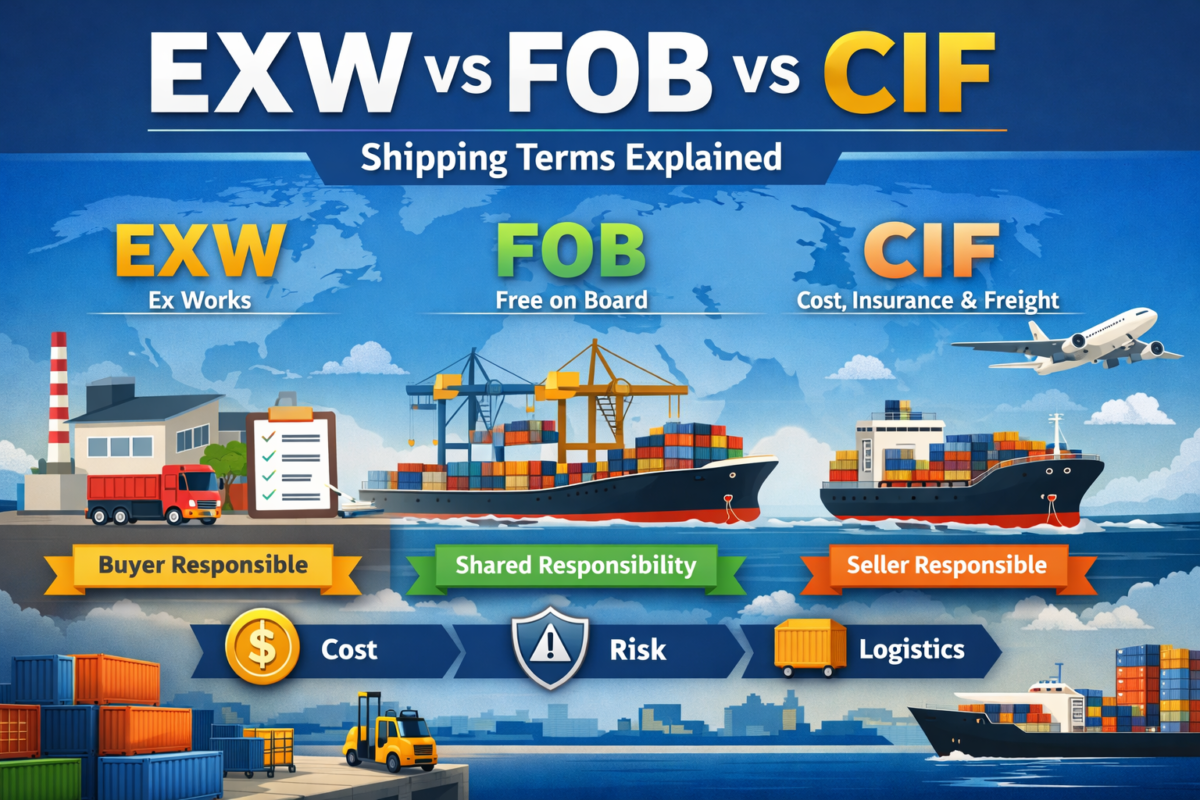
When sourcing from China, one of the first decisions that can affect your total landed cost, risk exposure, and logistics control is choosing the right shipping term. The three most common terms you will see in supplier quotations are EXW, FOB, and CIF.
For overseas buyers, especially importers sourcing from China for the first time, understanding these terms is essential because they determine who pays for transport, who handles export clearance, and when the risk transfers from seller to buyer.
This decision directly impacts:
- Your total landed cost
- Your risk exposure
- Your control over logistics
- Your profit margins
As a China-based sourcing partner, we’ve seen buyers lose 10–40% of margins simply due to incorrect shipping term selection.
This guide breaks it down strategically (not just definitions)—with real-world scenarios, cost structures, and sourcing insights.
What Are Incoterms (And Why They Matter)
Incoterms are globally standardized trade rules issued by the International Chamber of Commerce that define who is responsible for costs, risks, and logistics at each stage of shipping.
- Used by 45+ million companies across 170+ countries
- Current version: Incoterms 2020 (11 terms total)
- Most commonly used in global trade: EXW, FOB, CIF, DDP
👉 But in China sourcing, EXW, FOB, CIF dominate ~80%+ of transactions (industry observation across trading/export operations).
Quick Comparison: EXW vs FOB vs CIF
| Factor | EXW | FOB | CIF |
|---|---|---|---|
| Responsibility | Buyer handles everything | Shared | Seller handles most |
| Risk Transfer | At factory | At port (on vessel) | At port (on vessel) |
| Cost Visibility | Low (hidden costs) | Medium | High (but inflated) |
| Control | Maximum | Balanced | Minimum |
| Best For | Experienced importers | Most buyers | Beginners / low volume |
1. EXW (Ex Works) – Maximum Buyer Responsibility
The seller makes the goods available at their factory or warehouse, and the buyer handles almost everything else, including export clearance, inland transport, and international freight.
What It Means
Under EXW, the supplier’s job is simple:
Goods are made available at factory—everything else is your responsibility.
Buyer handles:
- Factory pickup
- Inland transport (China)
- Export clearance
- Ocean/air freight
- Insurance
- Import duties & delivery
Seller handles:
- Manufacturing
- Packing
Real-World Case Study (Common Mistake)
A US buyer sourced goods:
- EXW price: $80,000
- Final landed cost: $110,000 (+37%)
Why?
- Inland China trucking
- Export documentation
- Port handling charges
- Freight fluctuations
This type of cost escalation is extremely common under EXW.
When EXW Makes Sense
✔ Large importers with logistics teams
✔ Buyers consolidating multiple suppliers
✔ Companies negotiating freight directly
Risks of EXW (Important)
- Supplier may not support export clearance (very common in China)
- You rely heavily on freight forwarders
- High coordination complexity
In practice, EXW is often misused in China—many factories quote EXW but expect help with export.
2. FOB (Free on Board) – The Industry Standard
FOB is often considered the most balanced and popular term for sea freight. The supplier handles domestic transport and export clearance in China, then the buyer takes responsibility once the goods are loaded onto the vessel.
What It Means
Supplier handles everything until goods are loaded on the ship.
Risk transfers once goods are on board the vessel.
Seller handles:
- Inland transport to port
- Export clearance
- Port handling
- Loading on vessel
Buyer handles:
- Ocean freight
- Insurance
- Import clearance
- Final delivery
Why FOB is Most Popular
FOB is the default choice for serious importers because:
✔ Balanced control
✔ Transparent cost structure
✔ Lower risk vs EXW
✔ Better freight negotiation power
Best For
-
Importers who want control over international freight.
-
Buyers working with freight forwarders.
-
Sourcing companies that want a cleaner division of responsibility
Cost Advantage Example
| Component | EXW | FOB |
|---|---|---|
| Factory Price | Lower | Slightly higher |
| Hidden Charges | High | Low |
| Total Cost | Uncertain | Predictable |
FOB often results in better total landed cost visibility, even if unit price is higher.
Practical Insight (From China Sourcing)
Many Chinese suppliers:
- Prefer EXW (less work)
- But are actually structured for FOB exports
This is why FOB is the most efficient working model with Chinese factories.
3. CIF (Cost, Insurance & Freight) – Maximum Convenience
CIF means the seller arranges and pays for ocean freight and insurance up to the destination port, but the buyer still assumes risk once the cargo is loaded onto the ship.
What It Means
Supplier arranges:
- Freight
- Insurance
- Delivery to destination port
However, risk still transfers at origin port (not destination).
What Seller Covers
- Export handling
- Ocean freight
- Insurance (minimum coverage)
What Buyer Still Handles
- Destination port charges
- Customs clearance
- Import duties
- Last-mile delivery
Hidden Reality of CIF (Critical Insight)
Many buyers assume CIF = “everything included”
❌ Not true
You may still pay:
- Destination port fees
- Terminal handling charges
- Customs clearance
- Delivery
CIF only covers freight till port—not full delivery
Cost Risk (Important)
- Seller chooses freight → may be overpriced
- Insurance = minimum coverage only
- Less transparency
CIF is often more expensive overall than FOB.
Key Difference: Cost vs Risk (Most Misunderstood Point)
Many importers confuse:
- Who pays
- Who takes risk
Critical Fact:
Even under CIF:
Risk transfers when goods are loaded on ship
Meaning:
- Supplier pays freight
- BUT buyer bears risk during transit
Strategic Comparison (Consulting View)
EXW → Control Model
- Maximum control
- Maximum complexity
- Suitable for scale players
FOB → Optimization Model
- Balanced cost vs control
- Best for growing importers
CIF → Convenience Model
- Low effort
- Higher cost
- Less transparency
Industry Data & Insights
- EXW often shows lowest quoted price but highest hidden cost risk
- FOB provides better cost negotiation flexibility
- CIF includes freight & insurance in customs value, increasing duty base
This directly impacts your import duties (especially in EU, India, Australia).
Real World Cases :Choosing Wrong Incoterm
Scenario: Amazon Seller (UK)
Product: Skincare Private Label
Volume: 1x 40HQ
| Term | Result |
|---|---|
| EXW | Delays + hidden China costs |
| CIF | Higher landed cost |
| FOB | Optimal balance |
Final decision: FOB → saved ~12% cost vs CIF
How to Choose the Right Term (Decision Framework)
Choose EXW if:
- You have strong China logistics network
- You consolidate multiple suppliers
- You want full cost control
Choose FOB if:
- You want best balance of cost + control
- You’re scaling imports
- You work with sourcing agents
Choose CIF if:
- You are a first-time importer
- Small volume orders
- You want simplicity over optimization
Pro Tips from China Sourcing Experts
✔ Always calculate landed cost, not unit price
✔ Avoid EXW unless you control logistics in China
✔ Under CIF, ask:
- Which forwarder?
- What insurance coverage?
- What’s excluded?
✔ Use FOB + your forwarder for scalability
Final Conclusion
EXW, FOB, and CIF are not just shipping terms—they are strategic decisions that impact your entire supply chain.
- EXW → Cheapest on paper, riskiest in reality
- FOB → Best balance (recommended for 80% of buyers)
- CIF → Convenient but often expensive
Smart importers don’t ask:
“Which is cheaper?”
They ask:
“Which gives me the best landed cost, control, and risk balance?”
Which Term Is Best?
There is no universal winner, but for many China sourcing businesses, the decision usually looks like this:
-
EXW if you have strong logistics capability in China and want full control.
-
FOB if you want the best balance of control, cost transparency, and operational simplicity.
-
CIF if you are a newer buyer and want the seller to arrange freight and insurance to the destination port.
What do we recommend ?
As a sourcing company in China we do not treat all orders same. The best recommendation depends on the buyer’s experience, shipment size, destination country, and freight strategy.
For many customers, FOB is the safest default recommendation because it reduces supplier-side confusion, keeps export responsibility in China, and allows the buyer or sourcing agent to control shipping costs more effectively.But for someone who have strong logistics network in China and just need s for sourcing we recommend EXW .
For other who do not want any hassle and want the products to reach their door , we also offer DDP shipping .
DDP is the most seller-responsible shipping term, where the supplier handles everything from factory to final delivery at your doorstep. This includes export clearance in China, international freight, customs clearance in the destination country, import duties, taxes, and last-mile delivery.
For buyers, DDP offers maximum convenience and predictable landed cost, since you receive goods without managing logistics.
Frequently Asked Questions (FAQ)
1. What is the main difference between EXW, FOB, and CIF?
The key difference lies in who handles costs, risks, and logistics.
- EXW (Ex Works): Buyer handles everything from factory onward
- FOB (Free on Board): Seller handles export & loading; buyer handles freight
- CIF (Cost, Insurance & Freight): Seller arranges freight & insurance, but risk still transfers at origin
In simple terms:
EXW = Maximum buyer responsibility | FOB = Balanced | CIF = Maximum seller involvement (but limited control)
2. Which shipping term is best for importing from China?
For most importers, especially scaling businesses:
FOB is the best option
Because it offers:
- Better cost transparency
- Lower risk vs EXW
- More control vs CIF
EXW is suitable for experienced buyers, while CIF is better for beginners with small shipments.
3. Is EXW cheaper than FOB or CIF?
On paper, yes—but in reality, not always.
EXW often appears cheaper because:
- It excludes logistics costs
However, buyers usually face:
- Hidden charges in China
- Higher freight handling costs
- Coordination inefficiencies
Final landed cost under EXW can be 10–30% higher than expected.
4. Does CIF include all costs until final delivery?
No, this is a common misconception.
CIF includes:
- Freight to destination port
- Basic insurance
But does NOT include:
- Destination port charges
- Customs clearance
- Import duties
- Last-mile delivery
CIF only covers transport to port—not door delivery.
DDP covers all the costs until final delivery.
5. When does the risk transfer in FOB and CIF?
In both FOB and CIF:
Risk transfers when goods are loaded onto the ship at the origin port
This means:
- Even under CIF, the buyer bears transit risk
- Insurance provided by the seller is usually minimal
6. Why do Chinese suppliers often prefer EXW?
Chinese factories prefer EXW because:
- It reduces their responsibility
- No need to handle export clearance
- Less coordination required
However, many factories are actually structured for FOB, which is why FOB works more efficiently in most cases.
7. Can I negotiate shipping terms with suppliers?
✔ Yes, absolutely.
You can:
- Ask for both EXW and FOB pricing
- Compare landed cost scenarios
- Shift from CIF to FOB using your own forwarder
Professional buyers always negotiate Incoterms along with price.
8. Which term gives the most control over logistics?
EXW gives maximum control, followed by FOB.
- EXW → Full control but complex
- FOB → Balanced control (recommended)
- CIF → Least control (supplier manages freight)
9. How do shipping terms affect import duties and taxes?
Shipping terms can impact your customs value:
- Under CIF → Freight & insurance are included → higher taxable value
- Under FOB → Only product + freight (separately handled)
This can slightly increase duties under CIF in some countries.
10. Should I use CIF for my first import order?
✔ Yes, if:
- You are a beginner
- Shipment size is small
- You want a simple process
But for scaling:
Switch to FOB for better cost control and efficiency.
11. What is the biggest mistake importers make with Incoterms?
Focusing only on unit price instead of landed cost
This leads to:
- Unexpected charges
- Margin loss
- Poor logistics decisions
✔ Always evaluate:
- Total cost
- Risk
- Control
12. How can a sourcing partner help with choosing the right Incoterm?
A sourcing partner (like a China-based agent) can:
✔ Compare EXW vs FOB vs CIF scenarios
✔ Negotiate better supplier terms
✔ Manage logistics & freight forwarders
✔ Ensure transparency in costing
This often results in 5–15% cost savings and fewer operational risks.