How to Find Reliable Manufacturers in China (Complete Guide 2026)
March 12, 2026
MOQ Explained: Understanding Minimum Order Quantity from China
March 19, 2026Alibaba vs 1688 vs Made-in-China: Which Platform Is Best for Sourcing from China?
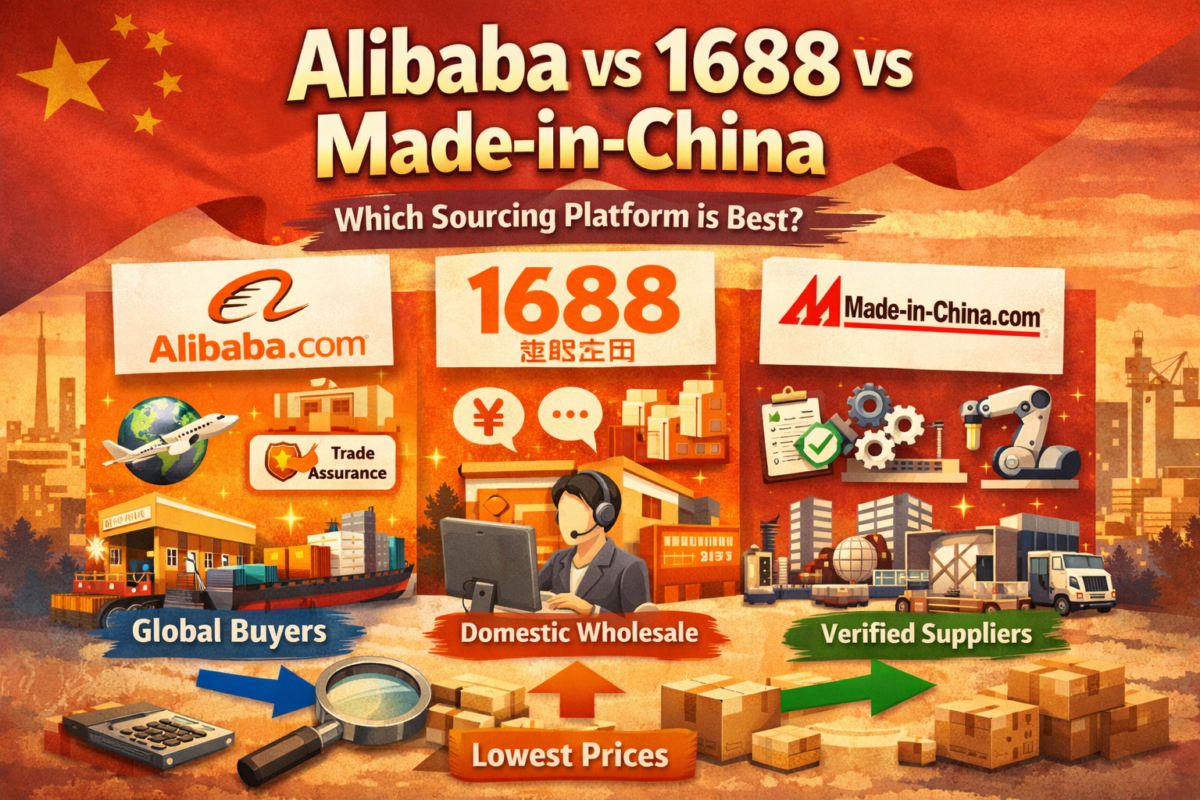
If you are sourcing from China, choosing between Alibaba vs 1688 vs Made-in-China directly affects your landed cost, risk, and scalability. Each platform serves a different type of buyer, with big differences in pricing, language, logistics, and buyer protection.
This pillar guide breaks down how each platform works, who it is best for, and how to decide which one matches your business stage and sourcing strategy.
Quick Overview of Alibaba, 1688, and Made-in-China
Before diving deeper, it helps to understand the core positioning of each platform.
-
Alibaba.com– Global B2B marketplace focused on international buyers, with English interface, worldwide shipping options, and built-in Trade Assurance.
-
1688.com – Domestic Chinese wholesale marketplace with RMB factory-level pricing, Chinese-only interface, and China-only shipping.
-
Made-in-China – Export-focused B2B directory and marketplace promoting verified Chinese suppliers to global buyers, with strong emphasis on certifications and industrial products.
These positioning differences drive the gaps in price, convenience, and risk that importers care about.
Feature-by-Feature Comparison
The table below gives a structured view of Alibaba vs 1688 vs Made-in-China to help you quickly see where each platform shines.
This comparison makes clear that price alone should not drive your choice; total cost, risk, and operational complexity matter just as much when sourcing from China.
Alibaba: Global-Friendly and “Plug-and-Play”
Alibaba is usually the first stop for international buyers because it is designed for global trade. The platform offers a user-friendly English interface, extensive product categories, and suppliers who are used to working with foreign clients.
Strengths of Alibaba for Sourcing from China
-
Global interface and support: The site and app are in English, and many suppliers have English-speaking sales staff, which reduces communication friction.
-
Convenient payment and protection: Alibaba supports global payment methods and offers Trade Assurance, which holds your payment until order conditions are met.
-
Worldwide logistics: Many suppliers can quote DAP/DDP solutions or at least help with freight to major ports, making logistics easier for new importers.
These advantages make Alibaba attractive for Amazon sellers, DTC brands, and SMEs that want a relatively simple way to start sourcing from China.
Limitations of Alibaba
-
Higher prices vs 1688: For the same or similar products, prices on Alibaba are often 20–30% higher due to export markups and trading-company layers.
-
Trading companies vs direct factories: Many listings are run by traders, not manufacturers, which can affect transparency on cost and production control.
-
Still requires vetting: Trade Assurance helps, but you still need to verify suppliers, check certifications, and arrange inspections.
If you are willing to pay a bit more per unit in exchange for safety, structure, and support, Alibaba is often the best starting platform.
1688: Lowest Prices, Highest Complexity
1688.com is Alibaba Group’s domestic B2B marketplace, designed for Chinese buyers, not foreigners. It lists factory and wholesaler prices in RMB for a huge range of products, often significantly cheaper than the same items on Alibaba.
Why 1688 Is So Cheap
-
Domestic factory pricing: 1688 connects you directly to factories and primary wholesalers selling into China’s competitive market.
-
Lower margins and high competition: Vendors compete aggressively on price, which drives down per-unit costs by 20–50% compared with international-facing platforms.
-
RMB-only environment: Prices are in RMB and target local buyers, so there is no export markup built in for foreign customers.
This structure makes 1688 particularly attractive for importers with a China presence or a reliable local sourcing partner who can manage the on-the-ground work.
Hidden Costs and Risks of 1688
-
Language barrier: The website and app are in Chinese, and while browser translation helps, it is not perfect for technical or contractual details.
-
Domestic-only logistics: 1688 suppliers typically ship only within China; you must manage export packaging, customs clearance, and international freight separately.
-
Payment and protection: Local buyers use Alipay, WeChat Pay, or Chinese bank accounts; foreign buyers usually need a sourcing agent or local company to pay on their behalf, and there is no Alibaba-style Trade Assurance.
Because of these issues, 1688 shifts a lot of operational responsibility and risk to the buyer, which is why many international sellers pair it with a trusted China sourcing company or agent.
Why international buyers abandon 1688 after first order and stick with Alibaba despite higher prices.
International buyers often “try” 1688 for the low prices, but then revert to Alibaba because the real experience feels risky, slow, and hard to control, even if the unit cost is cheaper.
Below are the main reasons this happens, based on how 1688 actually works versus how most importers expect it to work.
1. Language and Communication Friction
-
1688 is fully Chinese-first: Interface, search, product descriptions, reviews, and checkout are all in Chinese; buyers end up relying on browser auto-translate, which breaks on technical specs and negotiation details.
-
Suppliers think “domestic first”: Many 1688 sellers don’t speak English and communicate via Aliwangwang in Chinese, so simple changes (logo, packaging, material) can take days of back-and-forth or get misunderstood.
After one stressful order with miscommunication, many foreign buyers feel that Alibaba’s English messaging and export-oriented suppliers are “worth paying extra for.”
2. Payments Are Awkward and Risky
-
Local RMB methods only: 1688 expects Alipay, WeChat Pay, or a Chinese bank account; most foreign buyers don’t have these, so they must use an agent, third-party service, or complex cross-border solution.
-
Perceived lack of safety: Without something like Alibaba Trade Assurance holding funds in escrow, payments on 1688 feel like a direct “send and pray” bank transfer, especially on first orders.
Once they have one tense payment experience, many importers decide it is safer and less stressful to keep paying via Alibaba with cards, PayPal, or bank transfer under Trade Assurance.
3. Logistics Become a Multi-Step Headache
-
1688 sellers usually ship only inside China: They send to a local warehouse, not to your country; the buyer must arrange consolidation, export customs, and international freight separately.
-
Fragmented, error-prone process: First order often involves domestic shipping to an agent, then repacking, export docs, and separate sea/air freight payments; delays or mistakes at any step destroy the “savings” feeling.
After wrestling with this once, many small and mid-size buyers prefer Alibaba’s semi-integrated international shipping options, where suppliers or platform partners handle most of the chain.
4. Hidden Costs Eat the Price Advantage
On paper, 1688 is often 20–50% cheaper at the product level than Alibaba. But the first real order exposes extra costs:
-
Agent or service fees to handle communication, payment, QC, and consolidation.
-
Extra domestic freight inside China plus repacking and warehouse handling.
-
Additional inspections and sampling to compensate for weaker buyer protection.
Guides that model the “true cost” of 1688 show that once you add these layers, the total landed cost is often close to, or even higher than, a clean Alibaba Trade Assurance order—especially for small or medium volumes.
5. Weak Buyer Protection and Dispute Handling
-
No international-style escrow: 1688 is built for domestic Chinese disputes, not overseas ones; there is no straightforward equivalent of Alibaba’s Trade Assurance with clear English processes.
-
Harder to resolve problems: If goods arrive short, wrong, or poor quality, foreign buyers have to argue in Chinese within a domestic dispute framework or rely entirely on their agent’s goodwill.
After one bad shipment where they feel powerless, many importers conclude that paying more on Alibaba is like paying an “insurance premium” for easier refunds and platform support.
6. Supplier Type and Export Readiness
-
Many 1688 sellers lack export licenses, documentation experience, and compliance know‑how (e.g., HS codes, test reports, labeling), because they’re used to serving only the Chinese market.
-
Alibaba suppliers are typically export-oriented, already used to Amazon/FBA, D2C brands, and global retailers, so they understand carton labels, barcodes, certificates, and destination‑market rules.
That difference matters a lot on the first one or two shipments, when a novice importer is still learning about customs and compliance.
7. Account, Trust, and “Default Loyalty”
-
Some foreign users face account restrictions or verification issues with 1688 that are hard to resolve from overseas, which kills confidence early.
-
B2B buyers often show “default loyalty”: once they have one workable solution (Alibaba + known suppliers), they stick with it unless there’s an overwhelming reason to switch.
So even if 1688 is theoretically cheaper, the switching cost in time, stress, and risk after a clumsy first experience keeps many buyers anchored to Alibaba.
Made-in-China: Certification-Focused B2B Export Platform
Made-in-China.com positions itself as a professional B2B platform connecting global buyers with verified Chinese suppliers, especially for machinery, industrial goods, and large projects. It emphasizes supplier auditing, certifications, and R&D capabilities more than pure price competition.
Strengths of Made-in-China
-
Verification and audits: The platform highlights verified or audited suppliers, which builds trust for high-value or technical purchases.
-
Industrial and OEM focus: It is particularly strong in machinery, equipment, and industrial components where technical specs and certifications matter.
-
Export-ready suppliers: Most suppliers are set up for export and familiar with documentation and compliance.
For buyers who prioritize technical quality, standards, and long-term OEM relationships over rock-bottom pricing, Made-in-China can be a strong option.
Limitations of Made-in-China
-
Less “e-commerce friendly”: Compared with Alibaba, it is not as focused on small MOQs, private-label consumer products, or dropshipping.
-
Fewer built-in protections: While suppliers may be audited, there is less structured transactional protection than Alibaba’s Trade Assurance.
-
Smaller share of “trendy” SKUs: Many e-commerce friendly, fast-moving consumer goods are more visible on Alibaba or 1688.
If you are sourcing industrial products or building a long-term OEM pipeline, Made-in-China is worth shortlisting alongside Alibaba suppliers.
Pricing and MOQ: Who Really Wins on Cost?
From a pure unit-price perspective, 1688 almost always looks cheaper than Alibaba and Made-in-China for the same category of products. However, serious buyers should look at total landed cost, not just the catalog price.
How Prices Compare
-
1688: Often 20–50% cheaper for matching or similar items compared with Alibaba, thanks to factory-level RMB pricing and intense domestic competition.
-
Alibaba: Higher than 1688 because many listings include export markup and trading-company margins, but still competitive globally.
-
Made-in-China: Pricing varies; suppliers often compete on quality and capabilities, not just price, especially in industrial categories.
For large, stable orders with a trusted China partner, 1688 can deliver substantial margin gains over time.
Minimum Order Quantities (MOQs)
-
Alibaba suppliers frequently offer lower MOQs to attract new brands and Amazon sellers, sometimes allowing 50–100 units for test orders.
-
1688 MOQs range widely; some sellers cater to micro-wholesale, while others expect larger carton or pallet-level orders.
-
Made-in-China suppliers tend to serve more traditional B2B orders, with MOQs aligned to industrial or project-based purchasing.
In early stages, slightly higher unit prices on Alibaba may still be cheaper overall if they let you test the market with lower MOQs and less operational complexity.
Logistics, Payments, and Buyer Protection
When sourcing from China, control over logistics and payment safety matters as much as price. Each platform offers a different combination of convenience and risk.
Logistics and Shipping
-
Alibaba: Many suppliers quote CIF, DAP, or even DDP, and Alibaba’s ecosystem includes logistics partners for door-to-door solutions.
-
1688: Suppliers focus on domestic shipping; you must use a freight forwarder or sourcing agent to consolidate goods and export them.
-
Made-in-China: Export-ready suppliers can work with your forwarder or arrange freight, but the process is more traditional and negotiation-based.
For new importers, Alibaba’s semi-integrated logistics is usually easier to manage than coordinating exports from multiple 1688 factories.
Payments and Protection
-
Alibaba Trade Assurance: Holds funds in escrow and releases payment only when the order meets agreed conditions, offering strong transaction-level reassurance.
-
1688 payments: Domestic methods only; foreign buyers typically pay via a China-based entity or agent, with domestic-style dispute mechanisms not tailored for overseas users.
-
Made-in-China: Emphasizes supplier verification while leaving transaction structure and protection largely to buyer and seller negotiations.
For companies without a local presence, paying factories through 1688 carries more risk unless you work with a trusted partner who can check goods and manage payments on your behalf.
Use Cases: Which Platform Is Best for You?
Instead of asking “Which platform is best?” in general, it is more helpful to ask “Which platform fits my current sourcing model, budget, and risk appetite?”
When Alibaba Is Best
Alibaba is usually the best fit if you:
-
Are a new importer, Amazon seller, or DTC brand testing a product idea.
-
Need lower MOQs, clearer communication, and easier logistics.
-
Value Trade Assurance and standardized processes more than chasing the absolute lowest price.
Alibaba lets you start sourcing from China with relatively low friction and then optimize costs later once products are validated.
When 1688 Is Best
1688 becomes the best option if you:
-
Already know your product and have validated demand.
-
Have or can build strong relationships with a China-based sourcing agent, office, or partner.
-
Want to aggressively lower your COGS by 20–50% on repeat orders and can handle more operational complexity.
Many successful brands start on Alibaba, then quietly switch to 1688 suppliers (often via agents) once volume justifies the extra work.
When Made-in-China Is Best
Made-in-China suits you if you:
-
Are sourcing machinery, industrial components, or technical parts.
-
Need verified factories with certifications and long-term OEM potential.
-
Are less sensitive to small differences in unit cost and more focused on reliability and compliance.
For many industrial buyers, Made-in-China is a useful complement to Alibaba during supplier discovery and RFQ stages.
Practical Tips to Maximize Results on Each Platform
To turn these platforms into real competitive advantages, you need a clear sourcing workflow rather than just browsing listings.
On Alibaba
-
Shortlist 5–10 suppliers per product, checking years in business, response rate, and certifications.
-
Use Trade Assurance POs with clear specs, QC standards, and shipping terms to reduce disputes.
-
Start with a small test order, then scale to better pricing tiers after quality is validated.
On 1688
-
Use a bilingual sourcing agent or local partner to communicate, negotiate, and verify factories.
-
Consolidate orders from multiple suppliers to one warehouse or forwarder before export to reduce freight costs.
-
Invest in third-party inspections before shipment since platform-level protection for foreign buyers is limited.
On Made-in-China
-
Filter for verified or audited suppliers and review technical documentation carefully.
-
Request detailed quotations with breakdowns for tooling, sample fees, and ongoing unit pricing.
-
Consider on-site factory audits for high-value or long-term projects.
With the right processes, all three platforms can support a robust, diversified China sourcing strategy rather than acting as stand-alone solutions.
Final Recommendation: How to Decide Today
For most businesses, the best answer to Alibaba vs 1688 vs Made-in-China depends on your maturity, risk tolerance, and product type.
-
If you are just starting sourcing from China and want safety and simplicity, start with Alibaba for first orders.
-
Once your products are validated and volumes grow, add 1688 (via a trusted China partner or sourcing agent) to reduce costs and improve margins.
-
If you are in machinery, industrial, or technical categories, layer in Made-in-China to access more specialized and certified Chinese factories.
Further ,When you are serious Import from China partnering with a dedicated sourcing company gives you a real edge over relying on platforms alone. With a team experienced in handling international business, you get clear, professional communication, better contracts, and smoother coordination across time zones.Because they already work with a diverse network of export-ready factories that can handle scalable volumes, you are not locked into a single supplier; instead, you gain access to multiple manufacturers in each category, allowing you to compare pricing, quality, and product variations before you decide.
This makes it much easier to build a strong, differentiated catalog, as your sourcing partner can quickly present a curated range of options tailored to your market and brand positioning. At the same time, they manage pre‑production sampling, in‑line checks, and post‑production quality inspections to ensure the goods that leave the factory match your standards.
Finally, they oversee the entire shipping process—coordinating with freight forwarders, preparing documents, and handling export formalities—so you can focus on sales and brand-building while they handle the complexity of sourcing from China.
If you are looking for a sourcing company to start or expand your sourcing journey from China ,feel free to Contact us today